

Reimbursement to an employee for expenses incurred in connection with or in the course of work constitutes business expenses that may be excluded from the social security contribution base and are therefore exempt from social security contributions, subject to the conditions and limits set forth in the decree of December 20, 2002 (as subsequently amended).
While reimbursing expenses that an employee can prove were incurred for the purposes of his or her professional activities and in the employer’s interest is a legal obligation, there is nothing to prevent the employer from setting maximum reimbursement amounts.
To prevent potential abuse by unscrupulous employees, it may even be prudent to include a contractual provision setting a maximum reimbursement amount for a night’s stay at a hotel or a meal at a restaurant. If it is difficult to determine a specific amount, it is also possible to specify a maximum category (for example, a ** or *** hotel).
Similarly, an employer’s decision to provide lump-sum allowances for business expenses—the amount of which is fixed and independent of the actual expenses incurred by the employee—is perfectly legal.
In fact, the employer may provide for two methods of reimbursement:
– reimbursement “based on actual expenses” corresponding to the amounts actually spent by the employee upon submission of supporting documents (hotel and restaurant receipts), noting that maximum reimbursement limits may be established;
– the payment of a lump-sum allowance for business expenses, regardless of the amount of expenses actually incurred by the employee (a prudent employer should, however, require the employee to provide proof that the trip in question actually took place).
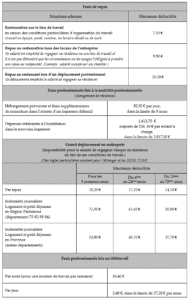
In the second scenario, lump-sum allowances for business expenses are excluded from the social security contribution base if they are used for their intended purpose; this condition is deemed to be met if the amount of the allowances does not exceed certain limits.
In other words, if the flat-rate allowance system for business expenses is chosen, it is possible to reimburse the employee an amount greater than what they actually spent without having to pay social security contributions, provided that this amount does not exceed the limits published by the tax authorities.
These limits are adjusted as of January1 of each year, and the limits applicable to expenses incurred in 2023 are as follows:
Dr. Aymeric Le Goff