

1. The establishment of the Social and Economic Committee (CSE) to replace existing institutions
A single, mandatory body for all companies
After several successive reforms of the social dialogue, the French-style multi-institutional system of employee representation (D.P., C.H.S.C.T., C.E.) will have completely disappeared by the end of 2019. These three bodies had clearly defined areas of responsibility, but they often tended to address the same subjects.
Admittedly, a single employee delegation (DUP) could be established, but it remained optional and was reserved for companies of a certain size.
The merger of all existing bodies into a single institution known as the Social and Economic Committee (CSE) must be implemented by January 1 , 2020, in all companies with 11 or more employees.
The response to the issues raised by business leaders
This modernization addresses a long-standing request from business leaders. It makes it possible to:
- mitigating the “threshold effect” for companies with more than 50 employees by eliminating the numerous financial and social obligations that currently act as a barrier to hiring for many companies;
- an overall reduction in costs (avoiding the accumulation of multiple positions by the same employee representatives; a reduction in the number of representatives and, consequently, in the number of hours devoted to union duties; a likely reduction in the number of meetings);
- the decline in the number of intermediaries capable of facilitating communication between employee representatives and company executives.
A single institution, but with responsibilities adjusted according to the size of the company
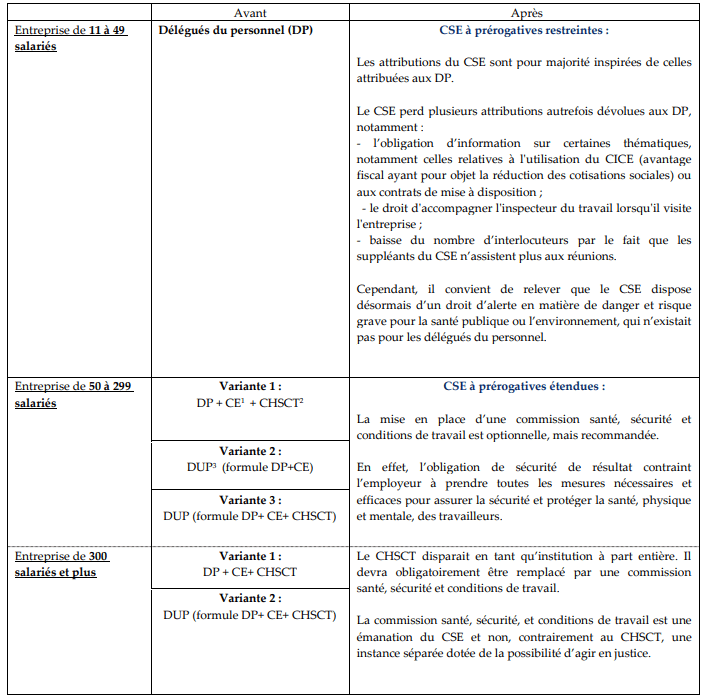
The reform, however, takes care not to impose additional burdens on employers of small businesses. Thus, in companies with fewer than 50 employees, the CSE will not have legal personality and will exercise so-called “limited” powers, which largely correspond to the powers previously entrusted to employee representatives.
In companies with 50 or more employees, the CSE will have broader powers, as it will assume the responsibilities and duties previously assigned to the former CHSCT and CE. Elected representatives will therefore have the opportunity to develop their skills and become more versatile in order to address a wide range of issues (economy, strategic direction, working conditions, health).
Let’s Focus on Social Dialogue to Create a Tailor-Made CSE
Synonymous with simplification and efficiency, the system leaves ample room for negotiation, allowing the social partners to adapt the institution’s operations to the needs of businesses. High-quality social dialogue and a thoughtful analysis of internal needs will undoubtedly enable companies to establish a tailor-made CSE.
2. Summary Table of Institutions Before and After the Reform: Changes and Continuity
3. Take Advantage of the New Negotiation Rules at My Company
The functioning of this body can be adapted within each company to enhance the effectiveness of social dialogue (A) with a view to making labor law more flexible through the conclusion of “win-win” company-level agreements that deviate from standard regulations and meet operational needs (B).
A. Establishment of a Customized CSE
A comprehensive review of all company-wide agreements relating to the former employee representative bodies
As part of the establishment of the CSE, all company-level agreements relating to the former employee representative bodies are null and void. In the absence of a new agreement, the statutory provisions automatically apply as of the CSE’s establishment.
In the absence of an agreement, legal provisions that are more favorable than before
However, the new legal provisions are less favorable to employee representative bodies: a reduction in the number of terms, a limit of three consecutive terms, a role for alternates limited to replacing regular members, and increasing pressure on the CSE’s operating budget due to the expansion of the rule requiring shared costs for expert opinions.
Greater negotiating leeway for employers
As a result, elected representatives will be much more open to negotiation than before. Employers should therefore take advantage of this in a “win-win” approach to further increase the flexibility of labor-management dialogue and the functioning of the CSE within their companies.
The list below outlines the main changes that can be made to the CSE through a majority collective agreement:
- establishment of “local representatives” to ensure that employee representation is as close to the front lines as possible;
- arranging for alternate members to attend certain meetings or committees in order to enable them to engage in their role as staff representatives and familiarize themselves with how the body operates;
- reduction in the number of meetings: provided that a minimum of 6 meetings per year is maintained;
- determining the number and scope of separate establishments, thereby enabling the establishment of a single Social and Economic Committee (CSE) at the company level or, alternatively, organizing the management of employee representative bodies according to the specific needs of each establishment (provided there is sufficient managerial autonomy);
- setting the operating budget for social and cultural activities;
- defining the content of ad hoc information and consultations;
- the terms and conditions of these ad hoc consultations, including the number of meetings;
- a reduction in the deadline for issuing an opinion (previously: a minimum deadline of 15 days) in the context of ad hoc consultations, provided that the time allotted to the CSE allows it to effectively exercise its authority, depending on the nature and significance of the issues submitted to it;
- negotiation of the content of the BDES[4].
B. Structuring corporate standards according to operational needs
The development of “win-win” company-level agreements is key to making French labor law standards more flexible and improving the competitiveness of businesses.
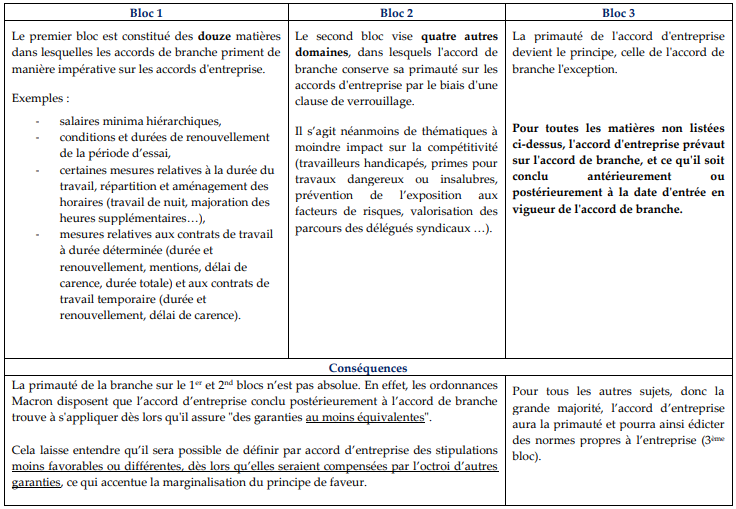
Principle of the Primacy of Company-Level Agreements
The Macron decrees expand the scope of company-level agreements over industry-wide agreements, thereby allowing companies to adapt certain regulations to their specific operational needs:
Facilitating restructuring through collective agreements
Finally, apart from these three areas, “restructuring” measures are greatly facilitated when they are not contingent on the conclusion of a company-wide collective agreement. Economic difficulties, which were once required to implement the necessary changes, are no longer a prerequisite. One of the flagship measures of the Macron reform, known as the “collective contractual termination,” allows employers to negotiate with unions the number of departures and the associated terms.
Simpler, less expensive, and more legally secure, employers now have considerably greater room to negotiate.
Dr. Aymeric Le Goff, Alizée Poncet
[1] Works Council
[2] Health, Safety, and Working Conditions Committee
[3] Single Employee Representative Body
[4] Economic and Social Database: a tool used to compile the information needed for regular consultations with employee representative bodies.